Foundation repair in Ontario ranges from $500 for a single crack injection to $120,000 or more for full perimeter underpinning. The right number depends entirely on what is wrong with your foundation. Crack injection, carbon fibre straps, wall anchors, localized footing repair, and full underpinning each address a different problem at a different cost. This guide covers real pricing for every major repair type so you can evaluate quotes accurately.
Foundation Repair Cost Summary
| Repair Type | Typical Cost Range | What It Addresses |
|---|---|---|
| Crack injection (polyurethane) | $500 to $900 per crack | Water entry through stable crack |
| Crack injection (epoxy) | $700 to $1,200 per crack | Structural bonding of stable crack |
| Carbon fibre straps | $3,000 to $8,000 | Bowing wall reinforcement |
| Wall anchors | $5,000 to $12,000 | Bowing wall stabilization and recovery |
| Localized footing repair | $8,000 to $25,000 | Settlement at one section of footing |
| Full underpinning | $50,000 to $120,000+ | Foundation inadequacy, height increase |
| Foundation wall replacement | $15,000 to $40,000 per wall | Severely damaged or collapsed wall |
| Structural engineer assessment | $500 to $1,500 | Diagnosis before any repair |
Crack Injection: $500 to $1,200 per Crack
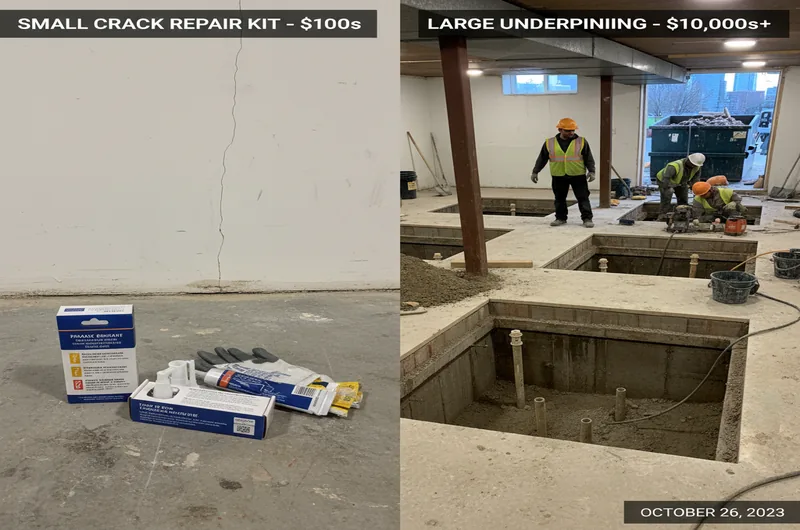
Crack injection costs $500 to $1,200 per crack and is the most common foundation repair in Ontario. It seals water entry through a stable concrete wall crack using either polyurethane foam or structural epoxy. It seals an existing crack in a poured concrete wall to prevent water entry and, with epoxy injection, restores some tensile strength across the crack.
What drives variance in crack injection cost:
- Crack length (longer cracks require more injection ports and more material)
- Access difficulty (finished basement walls require drywall removal before injection)
- Injection method (polyurethane is less expensive than epoxy; polyurethane is used for active water, epoxy for structural bonding)
- Number of cracks being addressed simultaneously (multiple cracks on one visit are usually discounted)
When crack injection is and is not appropriate: See the foundation crack repair guide for a full diagnostic framework. In brief: injection is appropriate for stable, vertical, non-displacing cracks in poured concrete walls. It is not appropriate for horizontal cracks, active settlement, or crack patterns indicating ongoing movement.
Carbon Fibre Straps: $3,000 to $8,000
Carbon fibre straps cost $3,000 to $8,000 installed and stabilize a bowing foundation wall against further inward movement. They do not correct existing bow, but prevent it from worsening. The straps are embedded in epoxy and anchored to the floor joist above and the foundation floor below, creating a tension member that resists further inward movement.
Carbon fibre straps do not correct existing bow. They prevent additional bow from occurring. If the wall has already bowed significantly (more than 25mm inward), straps alone may be insufficient and wall anchors or replacement may be required.
What drives variance:
- Number of straps required (typically one strap per 4 to 6 feet of wall)
- Wall accessibility (finished walls require demolition)
- Whether the floor joist above is in adequate condition to accept the upper anchor
Wall Anchors: $5,000 to $12,000
Wall anchors cost $5,000 to $12,000 installed and are used when a bowing wall has moved too far inward for carbon fibre straps alone. Unlike straps, anchors can be gradually tightened over time to recover some of the existing bow. A steel plate is installed on the interior wall face, connected by a steel rod to an anchor plate buried in the yard. The anchor provides resistance to inward wall movement, and in some cases the anchor can be gradually tightened over time to recover some of the existing bow.
Wall anchors are more expensive than carbon fibre straps but can be effective for more severely bowed walls. They require access to the exterior yard for anchor installation.
What drives variance:
- Number of anchors required
- Distance from the wall to stable soil (longer rods cost more)
- Yard conditions (landscaping, hardscaping, utilities in the anchor zone)
Localized Footing Repair: $8,000 to $25,000
Localized footing repair costs $8,000 to $25,000 and addresses settlement confined to one section of the foundation (one corner or wall segment), making it far less expensive than full perimeter underpinning when the problem is genuinely isolated. This is sometimes called partial or localized underpinning.
Localized footing repair involves excavating beneath the settled footing section, extending the footing to a stable bearing depth, and pouring new concrete. This addresses the settlement at that specific location.
The cost of localized repair is much less than full perimeter underpinning but still involves engineering, permits, concrete work, and inspections. Do not proceed without a structural engineer’s specification of the scope.
What drives variance:
- Length of the section requiring repair (a 10-foot section vs a 20-foot section)
- Depth of excavation required to reach stable bearing
- Access (narrow side yards, adjacent structures)
Full Underpinning: $50,000 to $120,000+
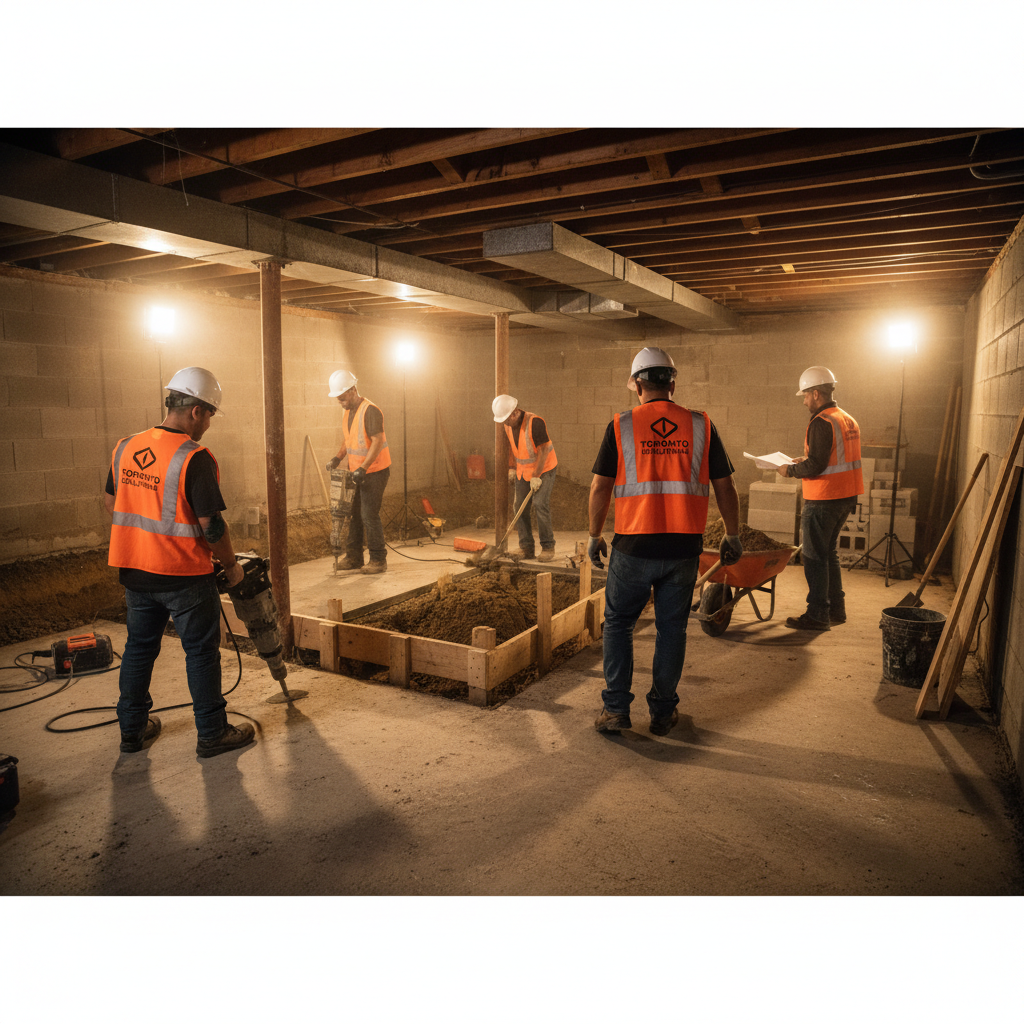
Full perimeter underpinning costs $50,000 to $120,000 or more and is required when existing footings are too shallow to safely bear the structure, or when settlement is distributed across the entire foundation rather than isolated to one section. It is also performed for non-repair purposes (increasing ceiling height, creating a secondary suite).
From a pure repair standpoint, full underpinning is required when:
- The existing footings are too shallow to bear the structure safely (common in pre-1920 homes)
- Settlement is distributed across the full perimeter rather than isolated
- The foundation walls are in such poor condition that repair is not practical
From a value-add standpoint, underpinning adds living space, ceiling height, and resale value beyond the repair function.
What drives variance:
- Perimeter length of the foundation (a larger home costs more)
- Depth of excavation (more depth means more concrete, more labour)
- Soil conditions (clay vs sandy soil affects excavation and formwork)
- Access (equipment access, tight urban lots in Toronto)
- Whether waterproofing is included in the scope
- Whether below-slab plumbing is being added simultaneously
For combined underpinning and interior waterproofing projects, the total cost is higher but the per-unit cost of the waterproofing component is lower due to shared mobilization.
Foundation Wall Replacement: $15,000 to $40,000 per Wall
When a foundation wall is too far gone for reinforcement (collapsed block, severely compromised poured concrete, significant bowing), replacement is required. The process involves shoring the floor structure above, demolishing and removing the existing wall, constructing a new poured concrete or block wall, and restoring any disturbed interior or exterior finishes.
This is a significant undertaking and one of the more expensive per-foot repairs. It is less common than the other repair types listed here but does occur in very old Toronto homes, particularly pre-war brick or stone foundations in the Annex, Parkdale, and Roncesvalles.
Structural Engineer Assessment: $500 to $1,500
The engineering assessment cost is small relative to any repair cost on this list. It buys you a confirmed diagnosis, a specified repair method, and sealed drawings if a permit is required. Without it, you are making a major financial decision based on a salesperson’s assessment.
Engineers who perform foundation assessments in Toronto typically charge $500 to $1,000 for a standard residential assessment and $1,000 to $1,500 for complex situations (party walls, heritage properties, multiple issues).
The assessment fee is often applicable toward the engineer’s fee for producing permit drawings, if structural work is confirmed.
Red Flags When Reviewing Foundation Repair Quotes
When getting quotes from contractors:
Red flag 1: The contractor does not recommend an engineering assessment before beginning work. For anything beyond crack injection, engineering is not optional.
Red flag 2: Pressure to commit quickly (“this price is only good today” or “I have another job lined up and this slot will close”). Legitimate foundation repair contractors do not use high-pressure sales tactics.
Red flag 3: A quote with no itemization, just a single total number. You cannot evaluate value or compare quotes without a breakdown.
Red flag 4: The contractor suggests omitting the permit to save money. For structural work, permits are not optional and skipping them creates serious legal and financial liability.
Red flag 5: Significantly lower price than all other quotes with no explanation. Cheap foundation repair that does not fix the underlying problem is not a bargain.